- Published on
The Personality Matrix: A Design Idea in Progress
- Authors

- Name
- Jacob Walker
- @JacobWalker03
The Personality Matrix: A Design Idea in Progress
I’ve been turning an idea over in my head for a while: a way to represent who a character is—emotionally, mentally—inside the game world, and to let that representation actually matter for gameplay. Not just flavor text. Not just a few dialogue branches. Something that touches affinities, abilities, and how outside forces can push or pull on a character. I’m calling it the Personality Matrix, and it’s still very much a work in progress. Here’s where my head’s at.
What It Is (Right Now)
The Personality Matrix is an idea for classifying emotions, personality traits, or mental states within characters—and possibly AI entities—in a game world. Think of it as a structure that holds where a character “sits” emotionally or mentally. That position isn’t static: it can shift, be nudged, or be exploited. It can also influence what they’re good at, what they’re drawn to, and how they react.
So in practice:
- Traits influence gameplay — The matrix isn’t just lore. It could affect affinities (elemental, faction, whatever fits the world), which abilities unlock or resonate, and how certain interactions play out.
- A “Will” stat — I’m playing with the idea of a stat (tentatively “Will”) that represents how stable someone is inside the matrix. High Will might mean outside forces—other characters, skills, environmental effects—have a harder time shifting you. Low Will could make you more malleable, for better or worse.
- Skills and the matrix — Abilities could explicitly interact with the matrix: shifting emotional states, targeting specific nodes or regions, or exploiting existing alignments. So you’re not only dealing damage or healing; you’re sometimes operating on where someone is in this emotional/mental space.
- Not just the player — The same framework could apply to NPCs, enemies, and AI-driven entities. Everyone has a matrix; everyone can be read, influenced, or designed around it. That opens up encounter design and storytelling in a way I find interesting.
All of this is still conceptual. I’m not committed to exact axes or node counts—just to the idea that there is a structure, and that it matters.
The Structure (As I’m Sketching It)
When I draw it in my notebook, it looks like layers around a center.
Core — At the center there’s something like identity or class. In my notes I’ve been writing “Class?” and “Attunement!” there—the question mark because I’m still deciding how fixed or flexible the core should be. Attunement feels like the anchor: what the entity is at a fundamental level, before the personality layer does its thing.
Personality matrix — Wrapped around that core is the layer that actually holds the emotional/mental alignment. I picture nodes or regions here—different traits or states that can be strong, weak, or in flux. This is where “personality” lives in a way the game can read and use.
Protection / stabilization — Around that I’m imagining a buffer: something that keeps the matrix from flipping too fast. Without it, one spell or one conversation could rewrite a character. With it, shifts are more gradual, or cost something. That ties back to the Will idea—either as a direct stat or as a representation of how thick this outer layer is.
Skills — In the sketch, I have arrows coming in from the outside: “Skills?” hitting the matrix layer. The idea is that abilities don’t only target HP or stamina; they can target nodes or zones in the matrix, causing shifts, temporary states, or lasting changes. Still fuzzy on the details, but the direction is: skills interact with the structure.
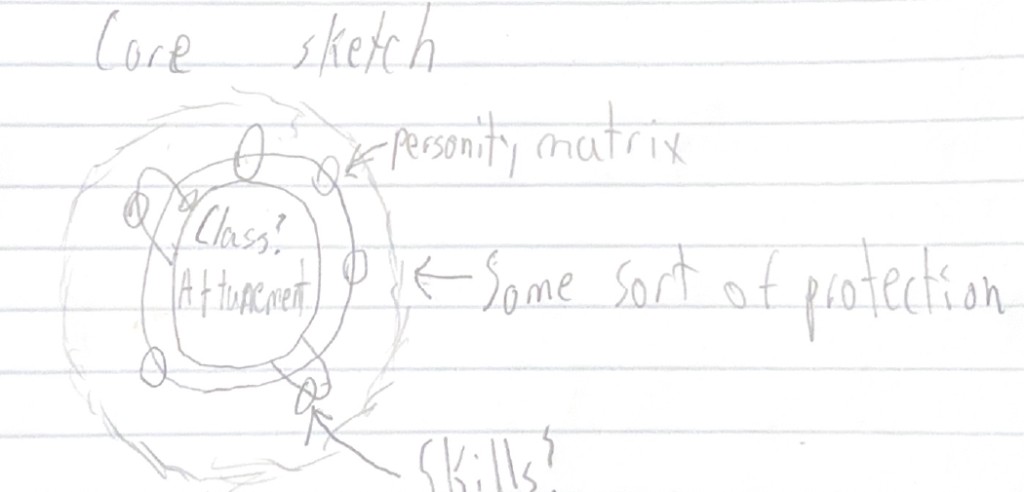 Core sketch from my notebook
So: core identity → personality matrix → stabilization → and skills poking at the matrix. That’s the picture I’m working from.
Lore and Affinity
I’m also playing with the idea that the matrix isn’t only a gameplay hook—it’s a lore mechanic. Entities in the world could have natural affinities tied to their personality alignment. Certain places, factions, or types of magic might resonate with certain regions of the matrix. So when you meet someone or something, their “place” in this structure could explain why they’re drawn to X or vulnerable to Y, and that could feed into both narrative and systems. Still early, but it’s a direction I like.
Visualization: An “Inner World”
One thing I keep coming back to: what if the player could see it?
At higher levels or at certain moments, the idea would be to let the player enter an “inner world” or meditation state—possibly in VR—where they can visually explore their personality matrix as a space or structure. You’re not just reading “alignment: X”; you’re walking through it, seeing which nodes are strong, which are damaged or corrupted, which are in balance. That could represent personal growth, imbalance, or corruption in a way that feels concrete. It’s a big “maybe” and would be a significant feature, but it’s stuck in my head as a long-term possibility.
Another System in the Mix: VR Weapon Crafting
Separately, I’m working on a VR weapon crafting system where forging is driven by real motion—hammer swing velocity, direction, heat—so that strength and precision come from how you actually move. I’ve written a bit about that already.
The reason I mention it here: I’ve started wondering how these two ideas could connect.
- A character’s personality alignment could subtly influence how they craft. Not in a heavy-handed way—maybe just a nudge.
- Crafted weapons might inherit traits tied to the creator’s matrix. So what you make isn’t only a function of physical skill; it’s also a function of who you are in that moment.
- Emotional state or affinities could feed into outcomes—not replacing the motion-based system, but layering on top of it. Same swing, different “flavor” or minor stat drift depending on where you are in the matrix.
None of that is designed yet. It’s just a thread I’m holding: two systems that might eventually talk to each other.
So that’s the Personality Matrix as it stands—a core RPG concept I’m still shaping. If you’re into game design or RPG systems and this sparks something, I’d be curious to hear how you’d push or simplify the idea. For now, it stays in the notebook and in these notes.
— Jacob